
Tag: witchcraft

  • End Witch Hunts Nonprofit Marks Three Milestones Across Its Podcast Network

    End Witch Hunts Nonprofit Marks Three Milestones Across Its Podcast Network

    Volunteer-Led, Descendant-Driven Nonprofit Reaches 200 Episodes, a One-Year Anniversary This May, a New Daily Feed, and 1,000 YouTube Subscribers

    End Witch Hunts is a Colorado-based, volunteer-led, community-driven social justice nonprofit. Through projects including posthumous exoneration, memorialization, podcasts, and public education events, the organization advances awareness of witch trial history and modern witchcraft accusations worldwide. Today the organization is celebrating three landmark moments across its history-centric podcast network: the 200th episode of The Thing About Witch Hunts on June 24th, the one-year anniversary of The Thing About the Salem Witch Trials on May 31st, the debut of Salem Witch Trials Daily as a standalone daily podcast this March, and crossing 1,000 subscribers on YouTube.

    Together, the three shows form the most comprehensive independent podcast network devoted to the history, human cost, and cultural legacy of witchcraft accusations.

    Two individuals posing for a promotional image with the text 'The thing about Witch hunts' in a decorative font above them.

    Hosted by Salem Witch Trials descendants Josh Hutchinson and Sarah Jack, The Thing About Witch Hunts has spent nearly four years building a remarkable archive of expert interviews, original research presentations, and co-host storytelling that spans centuries of persecution and connects historical witch trials, the demonologies and religious frameworks that made accusations possible, and popular belief across centuries, to modern-day accusations still devastating communities across the globe. With more than 160 guests since 2022, the show has drawn historians, human rights advocates, descendants, survivors, authors, artists, educators, activists, and more into conversation about why the same narratives of fear, accusation, scapegoating, and violence recur across radically different times and cultures. Across every episode the show confronts the stigma that has always made witchcraft accusations so devastatingly effective.

    A promotional image featuring two individuals, one with curly brown hair and the other with straight brown hair, both smiling. The background is purple, and the text reads 'The Thing About the Salem Witch Trials'.

    The Thing About the Salem Witch Trials zooms in on the most recognized witch trial in American history, the 1692 and 1693 Salem proceedings, examining them not as a moment of mass panic, but as deliberate legal machinery that destroyed real lives, drawing directly on the historic record to ground every episode in what the documents actually say. The show’s one-year anniversary this May marks a growing catalog of episodes that range from primary source deep dives to frank conversations about Salem’s ongoing fascination in film, fiction, and culture.
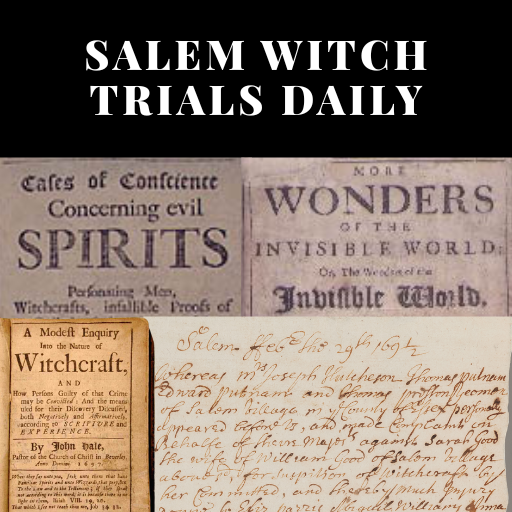
    A collage featuring historical documents and newspaper clippings related to the Salem Witch Trials, including articles about witchcraft and spirits, with the title 'SALEM WITCH TRIALS DAILY' prominently displayed.

    Salem Witch Trials Daily launches as a structured chronological course through the full Salem crisis of 1692 and 1693, offering listeners a day-by-day window into one of American history’s most documented tragedies, anchored in primary sources and the historic record of 1692 and 1693. The feed accompanies a free online course at aboutsalem.com, with a weekly blog and printable worksheets designed for both adult learners and young students.

    What makes this network singular is not only its scope, but its origin. End Witch Hunts is entirely volunteer-led. Its co-founders are documented descendants of Salem witch trial victims, including Rebecca Nurse and Mary Easty, who were condemned and executed in 1692. Advocacy for these women is not abstract. It is personal, genealogical, and generational. Co-host Josh Hutchinson brings his own ancestral reckoning to the work — his ancestor signed the first arrest warrant of 1692, the document that initiated charges against Tituba, Sarah Good, and Sarah Osborne. That shared lineage has become a gathering point, drawing descendant communities, researchers, and advocates from across the world into a collective effort to remember, exonerate, and protect.

    That advocacy has already produced concrete results. End Witch Hunts founders lauded the Connecticut Witch Trial Exoneration Project, which secured the 2023 passage of Connecticut House Joint Resolution 34, absolving 34 colonial witch trial victims. The organization continues to pursue posthumous exonerations, push for memorialization, and testify before state legislatures, including testimony before the Massachusetts General Court in 2025 in support of legislation to exonerate eight additional Boston witch trial victims.

    But the work is not only solemn. Witchcraft, magic, Halloween, and horror are woven into the programming with full sincerity, because the love of the witch in imagination and art is inseparable from the fear of the witch in law and history. The podcasts make space for both. Listeners encounter the Salem trials alongside discussions of witches on stage and screen from The Crucible to Wicked, witchcraft in contemporary film, the aesthetics of the Halloween witch, and the explosion of witch-centered storytelling across books, games, and social media. Witchcraft and magic are perennial forces in entertainment and popular conversation. End Witch Hunts positions that cultural appetite as a doorway, not a distraction.

    The shows reach listeners in more than 100 countries, ranked in the top 15% of video podcasts on Spotify in 2025, and crossed 1,000 subscribers on YouTube this year.

    “We are making space for the world to learn, discover, and talk about witch trial history, and about what it means that these accusations never stopped,” said Sarah Jack, Executive Director of End Witch Hunts. “The witch is everywhere in our imagination. The witch hunt never left the real world. Both of those things matter, and both belong in the same conversation.”

    “Descendants of the accused found each other through this work. That keeps happening, across countries and continents. We are proof that these histories still belong to living people and that these experiences still belong to the living.”

    Explore the Salem Witch Trials Daily course at aboutsalem.com, and become part of a growing global community at youtube.com/@aboutwitchhunts. Whether history brought you here or pop culture did, you belong in this conversation. This is a community built around a history we can still touch. Find us at endwitchhunts.org.


  • The Persistence of Deadly Belief: The Killing of Hellen Kamutumbe

    The Persistence of Deadly Belief: The Killing of Hellen Kamutumbe

    On March 20, 2026, Eneless Hellen Kamutumbe set out for a local market in the Kisasa area of Kalumbila District, Zambia.  The 46 year old wife and mother was there on a business trip from which she would never return.

    Moments after a slight physical encounter with 25-year-old Prince Ntambo, he shouted that Hellen had caused his genitalia to disappear. These loud allegations drawing  prompt attention pitted over 250 people against Hellen. This mob stripped her naked, pelted her with stones and struck her not only with sticks and wooden planks.

    In the midst of the chaos, one courageous bystander intervened, pulling Hellen from the crowd and bringing her into a nearby house in an attempt to save her. But the mob followed in hot pursuit.

    They dragged Hellen back outside, beat her again, and killed her, discarding her body on a nearby road. 

    Police response efforts were also met with violence. While it remains unclear exactly when officers arrived, it is known that the mob also threw stones at them, injuring three officers, and damaging the windscreen on the police vehicle hindering necessary intervention. Emergency  Assistance was contacted once the police located Hellen. However, it was too late. Hellen was pronounced dead when she arrived at the hospital.

    The earliest reports suggested that 17 people were arrested which has changed drastically due to serious, needed investigation.  As of March 24, 2026, 259 people have been arrested, including 93 women and the ongoing investigation may lead to even more arrests. Those charged are not eligible for bond and will remain in custody at least until their cases are heard. 

    This raises difficult and necessary questions.

    Were some of the women in the mob closely connected to Ntambo—perhaps even his girlfriends—who believed, in that moment, that Hellen had somehow “taken” his manhood simply by passing by or brushing up against him?

    Women-on-women violence in cases like this is particularly troubling. Women are often seen as protectors of one another, yet here, some stood at the forefront—participating in the stripping, beating, and killing of another woman.

    In the aftermath, the Senior Traditional Leader of the Lunda-speaking community, Chief Musele Musokantanda, ordered the Kisasa Market closed for two months which serves two purposes:

    1. A form of communal accountability for the failure of bystanders to protect Hellen.
    2. The establishment of a formal committee to identify who trades at the market and who owns trading spaces which would aid in the overall investigation.

    The closure of the market highlights a stark reality: when a community allows violence to unfold unchecked, the consequences ripple outward, affecting livelihoods, trust, and social stability.

    At the center of all of this is a truth that cannot be ignored:

    Hellen Kamutumbe did not commit a crime.

    There is no scientific reality in which one person can cause another’s body to physically alter or “disappear” through supernatural means.

    Thus, why was Hellen accused?

    The belief in “disappearing manhood” is a long-standing superstition found in parts of Southern and Central Africa. These accusations often emerge during periods of economic hardship, social anxiety, rapid urbanization, and cultural change.

    Zambia itself has faced significant challenges in recent years. A severe drought in 2024 led to major power outages and reduced agricultural output. Inflation remains high, and poverty affects an estimated 60% of households. At the same time, the population has grown dramatically—by roughly 43% between 1963 and 2022—contributing to overcrowding, informal settlements, and widening inequality.

    In such conditions, uncertainty breeds fear. 

    When panic takes hold, scientific reality can be hidden and overtaken by superstitious belief.

    Zambia is widely considered a Christian nation, and faith institutions play a powerful role in shaping belief systems. This places a responsibility on churches and religious leaders to actively address harmful myths and misconceptions, and to promote education that reduces the stigma surrounding witchcraft accusations.

    At the same time, there is a clear need for civil society organizations to step in—offering education, advocacy, and community-based interventions that challenge dangerous narratives before they turn violent.

    In response to this crime, the President has called on families to instill stronger values in their children. But this raises a critical question:

    Do those values include critical thinking?

    Because without the ability to question, investigate, and evaluate claims, belief can easily override truth. Education must equip people with the tools to challenge misinformation and resist fear-driven conclusions.

    Who teaches children how to think critically?

    Who prepares them to distinguish fact from superstition?

    Without those skills, even the most baseless accusation can become deadly.

    How does the belief that touching someone causing their genitalia to disappear tie into historical witch-hunts?

    In 1486, Heinrich Kramer published the Malleus Maleficarum, a manual for identifying and prosecuting witches that would shape legal systems across the Western world for centuries. In it, Kramer wrote that witches could make a man’s genitals vanish through touch. He called it a glamour — an illusion cast upon the senses. The body was untouched. The harm was not real. And yet he codified it as a prosecutable fact. That manual gave legal weight to the idea that a woman’s body was a weapon, that her touch could destroy a man, and that the man’s claim alone was enough to condemn her. Even when the harm was, by Kramer’s own definition, imaginary.

    Courts across Europe used it. And then colonial New England did too.

    In 1648, Margaret Jones of Charlestown, Massachusetts became the first person executed for witchcraft in the Massachusetts Bay Colony. The accusation against her centered on her touch. Those she laid hands on, the court was told, suffered for it. She was hanged.

    In 1662, eight-year-old Elizabeth Kelly of Hartford, Connecticut, died days after Goodwife Ayres visited her home and shared a bowl of broth with her. Her parents testified that Elizabeth cried out: “Goodwife Ayres is upon me. She chokes me. She kneels on my belly. She will break my bowels. She pinches me.” It was Ayres’s specter, not her physical presence, that the courts accepted as the weapon. The harm was invisible. The accusation was enough. That case ignited the Hartford panic and sent people to the gallows.

    By 1692, the doctrine was so deeply embedded that Salem courts accepted touch as direct evidence of guilt. The so-called touch test held that an afflicted person would be relieved of their torment when touched by the witch tormenting them. Rebecca Nurse, Mary Easty, and scores of others across Essex County faced accusers whose bodies were treated as instruments of proof. To touch someone and have them react was, in a Puritan courtroom, as good as a confession.

    These were not superstitions held by ignorant people on the margins of society. They were legal mechanisms, applied by educated magistrates, in functioning courts, with witnesses and records and sentences carried out by the state.

    That is what the Malleus Maleficarum built. A framework in which a woman can be killed for what a man claims her touch did to his body, and the legal and social machinery around her will not protect her. It will prosecute her.

    That framework did not disappear. It travels. It adapts. And on March 20, 2026, it arrived at a market in Zambia.

    Mob justice, also referred to as “instant justice,” harms communities by replacing truth with assumption, law with chaos, justice with violence.

    Technology now plays a significant role in these moments. In large crowds, someone is always recording which will later serve as evidence. As a result,  authorities can  identify and prosecute those involved.

    If this reality is incorporated into public education efforts, it could act as a deterrent—especially among younger generations who are constantly aware of digital visibility.

    Hellen Kamutumbe’s death forces us to confront an enduring question:

    How do societies address deeply rooted beliefs that can lead to violence?

    Horrific tragedies will continue if these beliefs are not challenged  with education, open dialogue, and critical thinking.

    And innocent lives will continue to be lost.

    Simple truths are powerful:

    Do not follow the crowd.

    Mind your own business.

    Because when fear drives action, lives are destroyed—not only for the victim, but for entire communities left to live with the consequences.

    End Witch Hunts condemns the killing of Eneless Hellen Kamutumbe and calls for full accountability for those responsible. Witchcraft accusations are not ancient history. They are a present and deadly reality.

    Wherever you are, you can help. Share this story. Say her name. Support organizations working to end witchcraft accusation violence worldwide.​​​​​​​​​​​​​​​​

    Sources: 

    NBC Digital News status update announcing arrests of 259 people

    Genital Disappearance: Senior Chief Museli orders closure of Kisasa Market for two months | Zambia Monitor

    17 suspects apprehended in Kalumbila District mob murder case | Mwebantu

    https://www.youtube.com/watch?v=JmdPbaPAT48
  • This Giving Tuesday, Stand Against Witch Hunts

    End Witch Hunts charts a solitary path as the only American nonprofit created for witchcraft accusation awareness and witch trial history. This Giving Tuesday, we’re asking you to stand with us in this vital work.


    A Unique Mission for Giving Tuesday

    We are the ONLY U.S. organization dedicated to ending literal witch hunts, both past and present. While witch trials may seem like distant history to many Americans, the reality is that witchcraft accusations continue to destroy lives around the world today including in the U.S. Additionally, here at home, victims of historical witch trials remain legally guilty centuries after their deaths.

    Our mission bridges these two realities: we work to restore justice to historical victims while raising awareness about contemporary witch hunts that still claim lives globally. This Giving Tuesday is your opportunity to support the only American organization with unique programming that includes two weekly podcasts featuring specialized experts from around the world dedicated to this crisis.

    What We Accomplished in 2025

    This year demonstrated the growth, breadth, and impact of our work:

    We presented educational programs in New England and Colorado, bringing witch hunt awareness into communities that introduced the  history and ongoing global crises. We consulted on building a Salem witch hunt exhibit at a community college library, helping ensure accurate historical information reaches students and the public.

    Through our two weekly podcasts, The Thing About Witch Hunts and The Thing About Salem, we created platforms for historians, advocates, and experts from around the world to share their specialized research. These podcasts amplify the voices of victims and survivors, past and present, ensuring their stories are heard and remembered world wide.

    We brought awareness to critical dates: World Day Against Witch Hunts on August 10, International Women’s Day on March 8, and International Albinism Awareness Day on June 13. These observances connect historical persecution patterns to contemporary human rights issues.

    We connected efforts to vital resources and networks, building bridges between advocates, researchers, and organizations working to end witchcraft accusations worldwide.

    And perhaps most significant to the U.S., we testified before the Massachusetts legislature to exonerate eight Boston witch trial victims who remain legally guilty after 375+ years. These men and women deserve justice, and we’re dedicated to clearing their names.

    100% Volunteer Run: Your Giving Tuesday Donation Goes Further

    Here’s what makes End Witch Hunts different: we are 100% volunteer run. Every single dollar you donate goes directly to our mission: education, advocacy, memorialization, and justice. We are dedicated volunteers working to end witch hunts and restore dignity to the accused. When you choose End Witch Hunts for your Giving Tuesday donation, you can be confident your gift creates maximum impact.

    Why This Work Matters

    Witch hunt history is too often misunderstood, trivialized, or dismissed entirely. The true stories of the real people who suffered and the behaviors that enabled their persecution have been lost to myth and misconception. We’re changing that narrative by bringing accurate history to light and helping communities understand what actually happened and why it matters today.

    Witch hunts didn’t end in the 17th century. They continue today in communities around the world, driven by the same fears, scapegoating, and accusatory behaviors that fueled historical persecutions. By helping people truly understand the past through rigorous research and expert voices, we equip them to recognize and address these same dangerous patterns in the present.

    When we work to exonerate historical victims, we’re not just correcting the legal record. We’re restoring their stories, closing centuries old chapters of injustice, and affirming that truth and dignity matter, even across the span of centuries.

    When we educate communities about the realities of witch hunt history and contemporary accusations, we’re building awareness that can save lives and prevent persecution. 

    Make Your Giving Tuesday Gift Count

    This Giving Tuesday, help us continue this vital work. Your Giving Tuesday gift, whether $10, $50, or $100, makes a real difference in our ability to educate, advocate, memorialize, and seek justice.

    Looking for a meaningful way to participate in Giving Tuesday 2025? Be the one to join us in standing against witch hunts, past and present.

    Donate today: www.endwitchhunts.org/donate

    Together, we can create a world where no one is persecuted for witchcraft accusations and where historical victims finally receive the justice they deserved all along. Make your Giving Tuesday donation to End Witch Hunts and support the only organization doing this critical work.

  • Justice for Witch Trial Victims: Supporting Massachusetts Bill H.1927

    Witch hunts didn’t end in colonial America. They continue today.

    End Witch Hunts is dedicated to educating the public about both historical and contemporary witchcraft persecution. Through our podcasts, social media, traditional media, publications, and presentations, we raise awareness about harmful practices related to accusations of witchcraft and ritual attacks worldwide, working toward their elimination. We collaborate with experts and policymakers, and we partner with organizations such as historical societies, libraries, museums, and educational institutions.

    Right now, the state of Massachusetts has an opportunity to demonstrate that confronting historical injustice matters, both for the past and for the present.

    Bill H.1927: Exonerating Massachusetts Witch Trial Victims

    Between 1647 and 1688, five women were executed for alleged witchcraft in Boston, Massachusetts: Margaret Jones, Elizabeth Kendall, Alice Lake, Ann Hibbins, and Goody Glover. These women endured false accusations, torturous examinations, and unjust executions based on fear and prejudice.

    Nearly four centuries later, their names remain tainted by wrongful convictions.

    Bill H.1927,“An Act exonerating certain individuals accused of witchcraft in colonial Massachusetts” will receive a hearing by the Joint Committee on the Judiciary on Tuesday, November 25, 2025 at 10:00 AM proposed by Rep. Steven Owens of Cambridge and Watertown, will clear the names of 8 individuals convicted of witchcraft in Boston and recognize all others who suffered witchcraft accusations in Massachusetts. This legislation represents more than clearing historical records. It’s about acknowledging injustice, honoring the memory of those who suffered, and demonstrating our commitment to learning from past mistakes.

    Massachusetts has exonerated all those convicted during the Salem witch trials of 1692 and 1693, but left these five women behind. They remain the only people executed for witchcraft in New England who have never been cleared. It’s time to finish the job.

    Why This Matters for Our Work

    Historical and Contemporary Witch Hunts Are Connected

    The same patterns that led to executions in colonial Massachusetts operate in witch hunts today:

    • Scapegoating outsiders and vulnerable community members
    • Targeting vulnerable women, especially those who are unprotected
    • Using fear to justify violence and injustice
    • Denying victims basic rights and due process

    In every nation around the world, people are still being accused of witchcraft. They still face violence, imprisonment, and death because of these accusations. Witch hunts never stopped. They continue globally with devastating consequences for victims and their families.

    When we advocate for Margaret Jones, Elizabeth Kendall, Alice Lake, Ann Hibbins, and Goody Glover, we also stand with every person around the world who is being accused of witchcraft right now. Their stories are separated by centuries but united by the same persecution, the same violence, the same injustice.

    Exoneration Sends a Powerful Message

    By formally exonerating these victims and acknowledging what was done to them, Massachusetts can demonstrate that it’s possible to confront injustice honestly, both historically and in its ongoing, present day reality. This legislation acknowledges that:

    • These women did not have a diabolical pact with the devil. They were innocent people falsely accused.
    • It was human agency that executed alleged witches, not a community deluded by the devil. People made these choices and people must take responsibility for the injustice.
    • Previous efforts are incomplete. Massachusetts has exonerated those convicted during the 1692-1693 Salem witch trials, but has never issued an official acknowledgment of all Massachusetts witch trial victims. Connecticut has completely absolved its witch trial victims and apologized to descendants. Massachusetts can follow this model and finish the job.
    • Witch hunting is not a relic of the past. Witch hunts continue today globally.  By understanding historical witch trials and acknowledging their injustices, we can better support communities currently grappling with witchcraft accusations, providing them with education and resources to resist violence and protect vulnerable community members from persecution.

    Building on Success: The Connecticut Model

    The Connecticut Witch Trial Exoneration Project was founded in 2022. On May 25, 2023, Connecticut passed House Joint Resolution 34, “Resolution Concerning Certain Witchcraft Convictions in Colonial Connecticut” by overwhelming bipartisan majorities. The resolution absolved 34 victims and apologized to their descendants.

    The Connecticut Witch Trial Exoneration Project connected the resolution to contemporary witch hunts, strengthening support for the legislation and educating the public about ongoing witch hunting.

    Now we’re supporting the Massachusetts Witch-Hunt Justice Project in achieving similar success for their victims.

    The Five Women Who Deserve Justice

    Margaret Jones (executed 1648) was a woman whose medicines were deemed too effective, her skill too powerful. When neighbors’ misfortunes occurred, she became the scapegoat. She maintained her innocence to the very end.

    Elizabeth Kendall (executed between 1647 and 1651) was falsely accused by a nurse who blamed her for a child’s death, a child who had actually died from the nurse’s own negligence. Even after the nurse’s fraudulent testimony was revealed, Elizabeth was never exonerated.

    Alice Lake (executed c. 1650) was a mother of four who had been judged harshly for choices she made as a young woman. That judgment haunted her and was weaponized against her when witchcraft accusations arose.

    Ann Hibbins (executed 1656) was called “quarrelsome” for speaking her mind and refusing to accept unfair treatment. Her husband had been an Assistant in the Massachusetts General Court, but even her connections couldn’t save her from being targeted as a widow with property.

    Goody Glover (executed 1688) was an Irish Catholic widow whose first language was Gaelic. An outsider within her community, she became an easy target when children exhibited strange behaviors.

    These women were not witches. They were healers, mothers, widows, and immigrants who became victims of fear, misogyny, and injustice.

    The Hearing: November 25, 2025

    The Joint Committee on the Judiciary will hold a hearing on Bill H.1927 on November 25, 2025. This is a critical opportunity for advocates, descendants, and anyone who cares about justice to voice their support.

    How You Can Support This Effort

    1. Sign the Petition

    Visit change.org/witchtrials and add your name to those calling for justice in Massachusetts.

    2. Submit Testimony

    Written testimony can be submitted to the Massachusetts Joint Committee on the Judiciary. Consider including:

    • Your connection to witch trial justice or End Witch Hunts’ mission
    • Why acknowledging historical injustice matters for addressing contemporary witch hunts
    • The truth that these were innocent people, not practitioners of harmful magic
    • How exoneration strengthens our collective commitment to human rights

    3. Share Widely

    Use your platforms to spread awareness about H.1927. Connect historical witch trials to ongoing persecution. Use hashtags like #H1927, #WitchTrialJustice, #EndWitchHunts.

    4. Contact Massachusetts Legislators

    Tell them you support H.1927. Explain why this matters not just historically, but for our understanding of persecution and scapegoating today.

    5. Learn More

    Our Broader Mission

    End Witch Hunts is dedicated to educating the public about both historical and contemporary witchcraft persecution. Our educational efforts include podcasts, social media, traditional media, publications, and presentations. We collaborate with experts and policymakers, and we partner with organizations such as historical societies, libraries, museums, and educational institutions.

    We proudly support the International Network Against Witchcraft Accusations and Ritual Attacks (INAWARA) and advocate for the implementation of UN Human Rights Council Resolution 47/8, which calls upon nations, NGOs, and individuals around the world to take actions toward ending harmful practices related to witchcraft accusations and ritual attacks.

    Our Projects Include:

    The Time to Act is Now

    Legislative windows can close quickly. The Massachusetts legislature needs to hear from citizens who care about justice, not just historical justice, but justice for all victims of witch hunting, past and present.

    Five women hanged for witchcraft have waited nearly four centuries for their names to be cleared.

    Will you be one of the voices that finally brings them justice?


    End Witch Hunts A vision for a world without witch hunts, where all victims are exonerated, modern victims and their families receive justice, and tribute is paid to past victims.

    For more information about our work, visit endwitchhunts.org To support Massachusetts exoneration efforts, visit massachusettswitchtrials.org To learn about Connecticut’s success, visit connecticutwitchtrials.org

  • Haiti witchcraft accusation-related massacre not an isolated event

    Massacre of more than 200 people following witchcraft accusations

    Over the days of December 6th through 11th, 2024, more than 200 people were brutally killed by a gang in the Wharf Jérémie neighborhood of Cité Soleil, Haiti. According to reports, after a child of gang leader Micanor “Mikanò” Altès became ill and eventually died, the leader consulted a Vodou bókò (a priest for hire), who advised him that older people in the area had bewitched the child. UN Secretary-General António Guterres has stated that 127 of the murder victims were seniors. Haiti’s National Human Rights Defense Network (RNDDH) has said they were killed “using machetes and knives.”

    Flag Haiti clip art

    The mass murder did not stop the child from passing from whatever truly ailed them, yet that may not stop the bloodshed. Some articles have stated that the gang leader has killed people over witchcraft claims in the past, as well. And the RNDDH reported that the area is under siege by members of the Viv Ansamn gang alliance, who continue to seek out elderly individuals and vodou practitioners.

    Witch hunts a worldwide problem

    The international community, including the United Nations and the African Union, have recognized the global crisis of harmful practices related to accusations of witchcraft and ritual attacks (that’s a fancy way of saying witch hunts and related attacks). In the past several decades, tens of thousands of individuals have been accused of witchcraft across dozens of nations. These accusations involve charges of using harmful witchcraft (maleficium) to hurt, kill, or damage. In retaliation for this alleged maleficium, accusers abuse and sometimes kill those they have accused of witchcraft. Abuse can be physical, including torture, sexual, including rape, or psychological, including inflicting trauma. In some cases, victims are publicly humiliated by being paraded naked or are forced to consume urine and human feces. Following many attacks, victims are forcefully banished from their towns or else led to move away out of fear of subsequent attacks. People today are dying from witchcraft accusation-related violence at a greater rate than what was seen in the European and American witch trials.

    Identification of witchcraft suspects by traditional healers, religious leaders, and others

    In many cases around the world, witchcraft has been alleged by religious leaders, healers, diviners, and spiritual entrepreneurs. Often, a person who has experienced loss or misfortune pays for the cause of their misfortune to be identified. In other situations, religious or spiritual leaders publicly denounce people as witches in order to draw crowds to their congregations.

    Belief in witchcraft is common globally

    Believing in evil witchcraft is not abnormal. In fact, across the world, 40% of people believe in witchcraft, as defined as belief “in the evil eye, or that certain people can cast curses or spells that cause bad things to happen to someone.” This is the malefic form of witchcraft which was targeted by the witch trials and continues to be targeted in witch hunts and, in some nations, trials, today. In some nations, 90% of people report holding this belief that they can be harmed by curses, spells, or the evil eye. Sweden has the lowest rate of belief, at 8.86%, and the rate is 16.47% in the United States. Witchcraft is a majority belief in 35 of the 95 countries included in the survey by Boris Gershman which established the 40% figure mentioned before. Belief levels this high are present in nations in Europe, the Americas, Asia, and Africa. And in 75 of the 95 surveyed nations, at least one quarter of the population believes in this form of witchcraft.

    Work is being done to end the crisis of witchcraft accusations

    In 2017, the first conference on witchcraft and human rights was held at the United Nations in Geneva, Switzerland. Since then, many significant steps have been taken in the effort to end witch hunts.

    In 2021, the UN Human Rights Council passed Resolution 47/8: Elimination of harmful practices related to accusations of witchcraft and ritual attacks.

    In 2023, the United Nations issued the final report on the situation of the violations and abuses of human rights rooted in harmful practices related to accusations of witchcraft and ritual attacks, as well as stigmatization.

    In 2024, the Second International Conference on Witchcraft and Human Rights, sponsored by the International Network Against Witchcraft Accusations and Ritual Attacks (INAWARA), convened at Lancaster University in Lancaster, England.

    UN Human Rights Council Resolution 47/8 (HRC 47/8) contains a set of guidelines for member states to follow in order to eliminate harmful practices within their borders and internationally. This is a global crisis that will require work by many member states to resolve.

    Following the adoption of HRC 47/8, the Pan-African Parliament, the African Union’s legislature, approved a set of guidelines for member states to take towards eliminating harmful practices and other human rights violations. These guidelines promote a holistic approach to combatting harmful practices. Topics include allocating funding and staff to ending these practices, establishing oversight, collaborating, and collecting data. The holistic approach also involves creating an enabling legal environment to combat harmful practices, as well as using non-legal and community-based interventions.

    In Papua New Guinea, sorcery accusation-related violence has long occurred at crisis levels. Aiming to eliminate this practice, the government adopted a Sorcery accusation-related violence National Action Plan (SNAP). Like the Pan-African Parliament Guidelines, the PNG SNAP calls for a holistic approach to solving the problem. Legal action alone will not stop witch hunts. All of government and society need to be involved in creating and implementing solutions.

    End Witch Hunts calls upon everyone to act to eliminate harmful practices

    End Witch Hunts condemns witch hunting in all its forms, including literal accusations of witchcraft, which often are accompanied by violence and other forms of abuse. We call upon people everywhere to demand that their governments take all necessary steps to eliminate harmful practices. The effort will take all of us. And find out if there is an organization near you that you can work with to take action.

    Stop attacking innocent people based on witchcraft accusations

    Instead of violence, use reason to determine the true cause of the harm. When misfortune or disaster strikes, don’t rush to blame your mother, grandmother, child, other relative, neighbor, or anyone else. Think critically about events and what natural processes cause them.

  • End Witch Hunts Special Report: Cruelty at Centerville Beach by Mary Bingham

    https://feeds.buzzsprout.com/2045153.rss

    Mary Bingham of End Witch Hunts presents the case of Kimberly Felder, a mother who believed her daughter was possessed by demons. The exorcism Kimberly performed on her daughter at popular Centerville Beach shocked and horrified witnesses. Fortunately, the 11-year-old girl’s life was saved by one of these witnesses.

  • Podcast Episode: The Link Between Dementia and Witchcraft Accusations with Berrie Holtzhausen

    https://feeds.buzzsprout.com/2045153.rss

    Welcome to Witch Hunt, where we uncover the ongoing crisis of modern witch hunts and harmful practices. 

    In this episode, we talk with Berrie Holtzhausen, founder of Alzheimer’s Dementia Namibia. Berrie’s incredible journey to become a dementia advocate highlights his dedication to educating communities where those with dementia are often mistaken for harming their community with witchcraft.

    Hear Berrie’s powerful stories of resilience, his fight against stigma, and his efforts to create dementia-friendly communities. Despite his own Alzheimer’s diagnosis, Berrie continues to rescue those falsely accused of witchcraft due to dementia symptoms.

    The Link Between Dementia and Witchcraft Accusations with Berrie Holtzhausen

    Alzheimer’s Dementia Namibia Facebook

    African Witchfinder Documentary 2018

    ‘They wanted her to confess to witchcraft’: ending the chilling effects of dementia stigma in Nigeria

    Donate: End Witch Hunts UK AdvocacyTrip Fund

    End Witch Hunts

    Connecticut Witch Trial Exoneration Project

    Massachusetts Witch-Hunt Justice Project

    Witch Hunt Website

    Salem Witch-Hunt Education Project

  • Podcast Episode: A Voice of Advocacy: Sashiprava Bindhani of Odisha, India

    https://feeds.buzzsprout.com/2045153.rss

    Sashiprava Bindhani, a human rights advocate and legal expert from Odisha, India, has dedicated her life to raising awareness of witch-hunting and advocating for the protection of vulnerable individuals.

    This impactful oral history conversation explores her life of advocating for individuals accused of witchcraft, examining the social ostracism, physical assaults, and the role of policy and legal intervention in protecting the vulnerable and stopping these practices. She shares her professional journey, personal experiences, and significant contributions to human rights. She discusses her work in law, public interest litigation, and efforts in implementing laws against witch branding. 

    A Voice of Advocacy: Sashiprava Bindhani of Odisha, India

    Sashiprava Bindhani Blog on Bhamati Ra Swara

    Justice for Lakhma

    End Witch Hunts

    Connecticut Witch Trial Exoneration Project

    Massachusetts Witch-Hunt Justice Project

    Witch Hunt Website

    Salem Witch-Hunt Education Project

  • Podcast Episode: Legal Perceptions of Witch-hunting in India with Riya A Singh and Amit Anand

    https://feeds.buzzsprout.com/2045153.rss

    In this episode, hosts Josh and Sarah explore the complexities of witchcraft legislation relating to witch branding and witch hunting in India. They are joined by Riya A. Singh, a third year law student specializing in human rights, and Dr. Amit Anand, an Assistant Professor of Law at Reva University. They discuss the differences in legal frameworks and implementation across Indian states, underscoring the urgent need for central legislation.The discussion highlights  how the shortcomings of current laws are impacting the lives of vulnerable community members. They address the importance of tailoring education, systemic changes, and community programs to fit the unique needs of each region. Join us for an insightful conversation on the urgent need for legal reforms and societal action to combat witch-hunting in India.

    Anti-Superstition Laws in India

    THE PREVENTION AND PROHIBITION OF WITCH-BRANDING AND WITCH-HUNTING AND OTHER HARMFUL PRACTICES BILL, 2022

    Come Visit Us On Youtube

    Sign the Petition to recognize those accused of witchcraft in Massachusetts

    ActionAid Report: “Witch-Hunting in Odisha”

    ActionAid Report: “Witch Branding in India”

    Join One of Our Projects

    Support Us! Buy Books from our Book Shop

  • Podcast Episode: The Once and Future Witch Hunt with Alice Markham-Cantor

    https://feeds.buzzsprout.com/2045153.rss

    We present a thought-provoking episode that considers the enduring legacy of witch hunts, tracing their historical roots through the Salem Witch Trials to the present day with Martha Carrier descendant and author Alice Markham-Cantor. Her personal journey and research, lead our reflection on the economic, political, and personal motivations driving witch hunts. Witch hunt history reveals how accusations of witchcraft, intertwined with social disputes and global dynamics, persist across time, necessitating a call for historical truth, awareness of ongoing injustices, and activism against this continuing phenomenon. Alice’s new book, The Once and Future Witch Hunt: A Descendant’s Reckoning from Salem to the Present, releases May 8, 2024, and stay tuned to awitchstory.com for updates on the new documentary, A Witch Story, featuring Alice.

    Buy the book “The Once and Future Witch: A Descendants Reckoning from Salem to the Present” By Alice Markham Cantor

    https://www.alicemarkhamcantor.com

    https://awitchstory.com

    United Nations Human Rights Council Resolution 47/8. Elimination of harmful practices related to accusations of witchcraft and ritual attacks  

    Report of the Office of the United Nations High Commissioner for Human Rights: Study on the situation of the violations and abuses of human rights rooted in harmful practices related to accusations of witchcraft and ritual attacks, as well as stigmatization

    ‘Witch Hunt’ Podcast Episode: Ending Sorcery Accusation Related Violence in Papua New Guinea with Miranda Forsyth

    ‘The Briefing’ Podcast Episode: Why Witch Hunts are Still Happening in 2024 with Miranda Forsyth

    End Witch Hunts

    Why Witch Hunts are not just a Dark Chapter from the Past

    The International Network against Accusations of Witchcraft and Associated Harmful Practices

    Grassroots organizations working with The International Network